|
|
Tai Lopez The Vault Top -
In the dynamic realm of self-improvement, few names command as much attention as Tai Lopez, an enigmatic figure whose journey from finance to motivational speaking has captivated millions. Known for his book "The One Thing," which emphasizes the power of singular focus, Lopez has extended his philosophy into fitness with the creation of The Vault Top , a bodyweight training program designed to sculpt upper body strength. This essay explores Lopez's influence, the mechanics of The Vault Top , and the broader implications of blending physical fitness with personal development. Tai Lopez’s career trajectory is a testament to his belief in reinvention. A former Wall Street trader turned bestselling author, Lopez leveraged his insights on success and mindfulness to build a global following. His transition into fitness is a natural extension of his philosophy: fitness, like goal-setting or mindfulness, is a tool for holistic self-mastery. This crossover from motivational content to structured physical training underscores his commitment to empowering individuals to take control of every aspect of their lives. Decoding The Vault Top : Structure and Philosophy The Vault Top positions itself as a barbell-focused bodyweight training program aimed at enhancing upper body strength and aesthetics. While the term "bodyweight" might suggest minimalist workouts using only gravity as resistance, Lopez’s approach integrates barbells to add intensity—implying a hybrid model. The program emphasizes progressive overload, a foundational principle in weight training, through variations of classic barbell exercises adapted for home use. By focusing on exercises like push-ups, pull-ups, and barbell rows, it targets functional strength, which is crucial for daily activities and athletic performance.
Wait, I need to make sure all the information is accurate. Let me check Tai's background again. He started in finance, became a motivational speaker, wrote bestselling books, and later expanded into physical fitness. So his transition makes sense as he talks about self-improvement in all areas. tai lopez the vault top
Need to verify if The Vault Top is a physical product (like a book or DVD) or a digital program (online course). That affects accessibility and user experience. In the dynamic realm of self-improvement, few names
In an era where fitness trends often prioritize novelty over substance, The Vault Top stands as a reminder that simplicity and discipline remain powerful forces. Whether it’s the ultimate path to upper body strength or a catalyst for self-discipline, Tai Lopez’s program invites us to reconsider the journey as much as the destination. Tai Lopez’s career trajectory is a testament to
Accessibility is another strength. With many gyms restricted by cost or location, The Vault Top offers an affordable, home-friendly alternative. Its structure—rooted in simplicity and discipline—resonates with those intimidated by overhyped fitness trends, promoting consistency over complexity. Lopez’s ventures are not without scrutiny. Some critics dismiss his fitness programs as marketing gimmicks, arguing that his claims lack peer-reviewed validation. Others question his lack of formal credentials in exercise physiology. Yet, his success lies in his ability to package motivational wisdom with actionable steps, appealing to a self-help audience that values mindset as much as methodology. Testimonials often highlight not just physical gains but also renewed confidence and discipline—a testament to his integrative approach. Conclusion: A Holistic Approach to Strength The Vault Top embodies Tai Lopez’s philosophy that physical fitness is intertwined with personal growth. While its barbell-centric structure may require a learning curve, the program’s emphasis on focus, consistency, and practicality aligns with broader trends in fitness. For those seeking a program that merges the physical and the philosophical, The Vault Top offers a compelling blend of accessibility and motivation. However, prospective users should balance Lopez’s insights with scientific rigor, perhaps consulting trainers to tailor the approach to their needs.
So, the essay needs to explore this program. I should discuss the background of Tai Lopez, his transition from being an author to a fitness trainer, which adds credibility. Then explain what The Vault Top is, its principles, methodology, and benefits. |
|
|
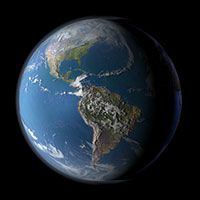
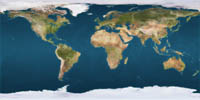
This map is a synthesis between my original earth map, gradient mapping of the USGS DEM information, hand painting, DEM modulation of detail, bathyspheric depth information, and the USGS Ocean clip. Bathyspheric data was used to modulate the color of the water so that deeper areas are a darker blue than shallow areas.
|
|
|
This is pieced together exclusively from the USGS DEM database. It contains landmass elevations only, with the ocean at zero, and the top of Mt. Everest at 255. Use this as a bump map to give the appearance of the Earth's rugged surface features. Some madmen have also used this data in POV Ray as a displacement map on a very finely divided sphere to produce a "true" 3D version of the Earth. The 10K version is VERY large, so make sure you really need that much detail.
|
|
|
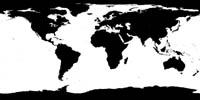
This is derived from USGS DEM data, with the addition of the Arctic ice areas which do not show up on USGS data (since they are not solid land masses.) Use this to control specularity and reflectance of the ocean surface.
|
|
|
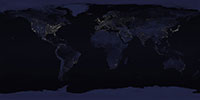
1024 x 512 color image. Very similar to the night lights map as published by NASA on their Blue Marble Page. I took their
30000 x 15000 black and white city lights map, and adapted it with a color table to a colorized version of my earth color map. This comes in 2k, 4k, and 10k versions in color, as opposed to the maximum 2k size of the NASA version of this map (higher resolution versions are available on the paid page only because of their size).
Be sure to have a look at the tutorials page for a special rendering tip for using this map. |
|
|
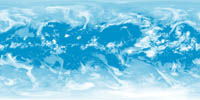
1024 x 512 color image. Based on a mosaic of satellite data, colorized, data errors retouched out, and fixed for seamless wrapping.
|
|
|
1024 x 512 greyscale image. Based on the same data as the color map, but leveled for the purpose of transparency mapping.
|
|
|
4096 x 2048 greyscale image. Built up out of real satellite imagery based upon a tutorial Dean Scott of Silicon Magic has posted. This is posted in JPEG2000 format. You need a special Photoshop plug-in to make use of jp2 images. I've thoughtfully provided a link:
JPEG 2000 Plugin from Fnord.
|
|
|
Tai Lopez The Vault Top -
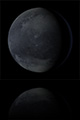
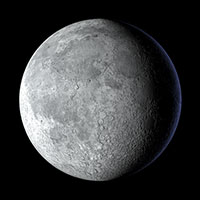
The Moon is a tricky planetoid to render. It has a very distinctive albedo which remains constant across its lit side, regardless of the angle of the surface to the sun. Therefore, standard rendering lighting models do not apply, as they always have a characteristic drop off in intensity as the angle of incidence to the light source increases. In Lightwave, there is an option to use a "non-Lambertian" lighting model on a surface setting. In previous versions of Cinema4D, you had a contrast control in the lighting setup. More recent versions of Cinema4D feature an Oren/Nayar illumination model in the lighting setup which allows you to simulate the lighting properties of "rough" surfaces. This is the method I used on the same pictured here.
|
|
|
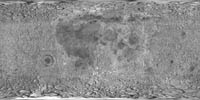
This map is based on a mosaic of satellite data, retouched for visible mosaic seams and for problems with the wrapping seam. Since this image contains highlight and shadow information independent of the location of your light source (inevitable because of how the moon is illuminated by the sun), you'll need to be careful how you light this so you don't break the illusion.
|
|
|
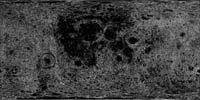
This map is my attempt to derive bump information from the above map. I did a high-pass filter operation to find all the edges of the craters, and then curved the result so that blacks and whites were white, and mid-tones were black. The results came out pretty well, as you can see from the sample image above.
|
|
|
|
|
|
this site works
best on Firefox:
|
|