Originally written: 3/14/2012; last Web page update: 3/13/2020, referencing rEFInd 0.12.0
This Web page is provided free of charge and with no annoying outside ads; however, I did take time to prepare it, and Web hosting does cost money. If you find this Web page useful, please consider making a small donation to help keep this site up and running. Thanks!
| Donate $1.00 | Donate $2.50 | Donate $5.00 | Donate $10.00 | Donate $20.00 | Donate another value |
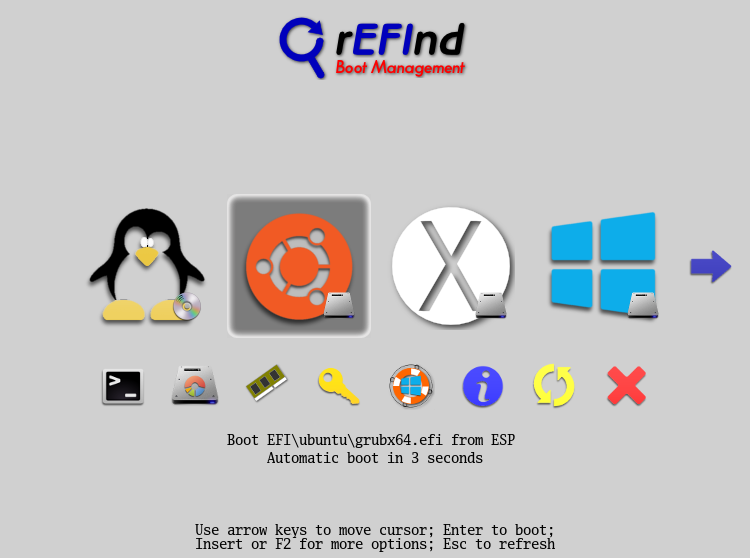
This page describes rEFInd, my fork of the rEFIt boot manager for computers based on the Extensible Firmware Interface (EFI) and Unified EFI (UEFI). Like rEFIt, rEFInd is a boot manager, meaning that it presents a menu of options to the user when the computer first starts up, as shown below. rEFInd is not a boot loader, which is a program that loads an OS kernel and hands off control to it. (Since version 3.3.0, the Linux kernel has included a built-in boot loader, though, so this distinction is rather artificial these days, at least for Linux.) Many popular boot managers, such as the Grand Unified Bootloader (GRUB), are also boot loaders, which can blur the distinction in many users' minds. All EFI-capable OSes include boot loaders, so this limitation isn't a problem. If you're using Linux, you should be aware that several EFI boot loaders are available, so choosing between them can be a challenge. In fact, the Linux kernel can function as an EFI boot loader for itself, which gives rEFInd characteristics similar to a boot loader for Linux. See my Web page on this topic for more information.
The intersection of desire and discipline, as embodied by Tushy and Carolina Sweets, offers a fascinating lens through which to explore the themes of obedience and power dynamics. While their performances are often fetishized and confined to the world of adult entertainment, the underlying psychology of obedience training has far-reaching implications.
In the world of BDSM and kink, obedience is often fetishized as a means of exploring power dynamics and submission. Tushy and Carolina Sweets, as performers, have leveraged this fetishization to build their brands and connect with their audiences. Their content often involves scenarios of dominance and submission, with a focus on obedience training and role-play. tushy carolina sweets obedience better
The world of adult entertainment often explores themes of power dynamics, submission, and obedience. Tushy and Carolina Sweets, two prominent figures in the industry, have built their careers around embodying these themes. Obedience training, in particular, has gained popularity in recent years, with many individuals exploring its applications in their personal and professional lives. This paper aims to examine the intersection of desire and discipline, using Tushy and Carolina Sweets as case studies, and discuss the implications of obedience training in various contexts. The intersection of desire and discipline, as embodied
As we continue to navigate the complexities of human desire and behavior, it is essential to approach these topics with sensitivity, respect, and an openness to exploration. By examining the intersections of desire, discipline, and obedience, we can gain a deeper understanding of human psychology and behavior, and perhaps even uncover new applications for obedience training in various contexts. Tushy and Carolina Sweets, as performers, have leveraged
While obedience training is often associated with kink and BDSM, its applications extend far beyond the realm of adult entertainment. In fields such as psychology, education, and business, obedience training can be used to improve performance, increase productivity, and enhance relationships.
Exploring the Intersection of Desire and Discipline: A Discussion on Tushy, Carolina Sweets, and Obedience Training
For instance, in a therapeutic setting, obedience training can be used to help individuals with anxiety or trauma develop coping mechanisms and regain control over their lives. In a business context, obedience training can be used to improve teamwork, communication, and leadership.
copyright © 2012–2020 by Roderick W. Smith
This document is licensed under the terms of the GNU Free Documentation License (FDL), version 1.3.
If you have problems with or comments about this Web page, please e-mail me at Thanks.
Return to my main Web page.